top of page


Why I Choose Cloudflare: Benefits, Features & My Experience
When I first started looking at Cloudflare, I thought of it mainly as a CDN and a tool that could make websites faster. But the more I explored it, the more I realized that Cloudflare offers much more than that. Today, when I think about website performance, security, DNS, DDoS protection, and modern web infrastructure, Cloudflare is one of the first platforms that comes to my mind. So, why would I choose Cloudflare? For me, it comes down to one simple idea: I want my website
7 min read


How SSL Secures The Internet
The internet has become an essential part of everyday life. From online banking and shopping to email, social media, and business applications, we regularly share sensitive information online. But how does this information stay protected while traveling between your device and a website? This is where SSL (Secure Sockets Layer) comes in. SSL is a security technology designed to protect data transmitted between a web browser and a website. Today, modern websites primarily use
8 min read


The Retry + Dead-Letter Pattern That Saved Us From Silent Message Loss
We run a set of NestJS microservices that talk to each other over Azure Service Bus queues. For a while, our error handling assumption was simple and wrong: "if the consumer throws, the message just gets redelivered." What really happened, a transient downstream failure would silently drop a message. Queue Message Drops Table of Contents The failure mode Azure Service Bus will redeliver a message if your handler throws and you don’t complete it but only up to maxDeliveryCount
3 min read


AI SEO: The Complete Guide to Optimizing for AI-Powered Search
Search engine optimization is entering a major new phase. For years, SEO was primarily about helping web pages rank in traditional search results. Businesses researched keywords, optimized title tags, built backlinks, improved technical performance, and created content designed to satisfy search algorithms. Artificial intelligence is changing that model. Modern search experiences increasingly use AI to understand queries, summarize information, answer questions, connect relat
12 min read


How Cache Knows Data Is Updated: TTL, Invalidation & Events
Caching is one of the most common techniques used to make applications faster. Instead of fetching the same data from a database or API every time a user requests it, an application can temporarily store that data in a cache. The next request can then be served much faster. But this raises an important question: If the original data changes, how does the cache know that its copy is no longer correct? The short answer is: a cache usually does not magically know. The applicatio
5 min read


Why Link Google Search Console with Google Analytics?
If you want to understand how people discover and interact with your website, two of Google's most useful tools are Google Search Console (GSC) and Google Analytics 4 (GA4). Google Search Console helps you understand how your website performs in Google Search, while Google Analytics helps you understand what visitors do after they arrive on your website. By linking Google Search Console with Google Analytics, you can bring these two perspectives together and get a clearer pic
6 min read


From Code to Container: Understanding Docker and Containerization
You’ve probably experienced this at some point. The application works perfectly on your laptop. The code runs, the tests pass, everything looks good and then someone deploys it to another machine and suddenly something breaks. Maybe the right version of Python isn’t installed. Maybe a package is missing. Maybe the operating system behaves differently. Or perhaps the application depends on a configuration that nobody remembered to document. This is one of the problems Docker w
10 min read


Cloud Architecture Best Practices: Building Scalable, Secure, and Resilient Systems
Cloud computing has fundamentally changed how organizations design, deploy, and operate applications. Businesses no longer need to purchase physical servers, build data centers, or manually provision infrastructure for every new project. Cloud platforms provide on-demand access to computing, storage, networking, databases, security services, analytics, and many other capabilities. However, moving an application to the cloud does not automatically make it scalable, secure, rel
14 min read


What is Cloud Architecture? A Complete Guide to Designing Scalable Cloud Systems
Cloud computing has changed the way organizations build and operate software. Instead of purchasing and maintaining physical servers, businesses can use cloud platforms to provision computing resources, databases, networking, storage, security services, and other infrastructure on demand. But simply moving an application to the cloud does not automatically make it scalable, secure, reliable, or cost-efficient. This is where cloud architecture comes in. This is not Cloud Archi
11 min read


GraphQL Is More Than an Alternative to REST
For years, REST has been the default language of web APIs. You create an endpoint, send a request, receive a response, and move on. That model works remarkably well until an application becomes complicated. Imagine opening an e-commerce application. The page needs your profile, recent orders, product information, inventory, reviews, recommendations, and delivery status. With a traditional REST architecture, the frontend may need to call several endpoints just to render one sc
13 min read
How to Send Email Notifications in Python Using Twilio SendGrid
Whether you are building an alert system for your application, sending welcome emails to new users, or delivering daily reports, email automation is a core requirement for most modern applications. While Twilio is famous for SMS and voice APIs, they power email through Twilio SendGrid one of the most robust email delivery services available. Here is a complete guide to getting your Python application to send its first email using the SendGrid API. Prerequisites Before diving
3 min read


Why is the Cloud Changing Again?
Remember when moving everything to "the cloud" was the ultimate tech upgrade? You finally packed up all those clunky on-site servers, sent your data off to a neat, invisible digital storage unit, and breathed a sigh of relief. But then, Artificial Intelligence exploded onto the scene, and suddenly, the old cloud rules went out the window. AI doesn't just passively store data; it actively devours it, requiring massive computing power and handling highly sensitive, proprietary
6 min read


From LLMs to Action: Understanding the Model Context Protocol (MCP)
Building enterprise AI applications has historically suffered from the "N × M integration problem." If you have M large language models (LLMs) and N internal tools (databases, APIs, file systems), developers had to build custom connectors for every possible combination. In late 2024, Anthropic solved this by introducing the Model Context Protocol (MCP). Think of MCP as the "USB port for AI" an open, standard protocol that allows any AI model to securely connect to any externa
3 min read


Recursive Language Models: The Model That Calls Itself
You've probably noticed something when using AI coding agents like Claude Code, Cursor, or Codex. The model doesn't just answer - it works. It reads a file, writes some code to search through it, reads another file, runs a check, and slowly pieces together an answer. It feels almost like watching someone think out loud. That intuition is important. Because a paper out of MIT CSAIL late last year - quietly titled Recursive Language Models - essentially formalizes exactly that
5 min read
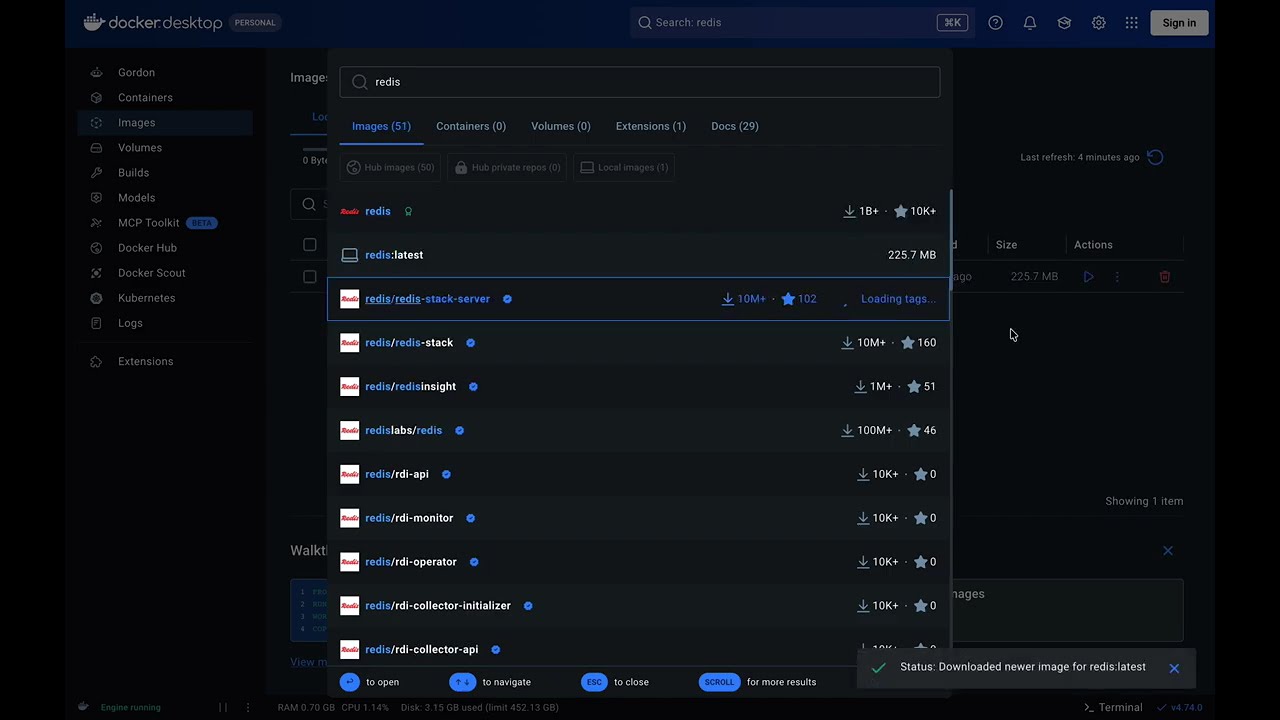
How to Setup Redis Using Docker Desktop on macOS
Redis is one of the most popular in-memory databases used for caching, real-time analytics, session storage, and message brokering. If you're using macOS, the easiest and cleanest way to run Redis locally is with Docker Desktop. Today, in this step-by-step guide, you'll learn how to: Install Docker Desktop on macOS Run Redis in a Docker container Connect to Redis Test your Redis setup Stop and restart Redis containers This tutorial is optimized for beginners, developers, and
3 min read
ReAct in AI Explained: How Reasoning and Acting Power Modern AI Agents
I was exploring a core concept about AI and AI Agents and frequently came across ReAct. As I kept seeing it, I thought to take a deeper dive and below is my understanding." Today’s AI models can search the web, use tools, solve multi-step problems, write code, and even interact with software environments. One of the most important concepts behind this evolution is ReAct. ReAct combines reasoning and action into a single framework, enabling AI systems to think step by step whi
4 min read


Firebase Studio is Shutting Down: What You Need to Know
With Google announcing its shutdown, many developers like me are now asking: 👉 Why is it being discontinued? 👉 What should you do next? Let’s break it all down in a simple, practical way. Firebase Studio is Shutting Down What is Firebase Studio? Firebase Studio is a cloud-based development environment (IDE) built by Google that allows developers to build full-stack applications directly in the browser. It combines: AI-powered coding assistance (via Gemini) Backend services
3 min read
Babel 101: Writing Future JavaScript, Today
If you’ve spent any time in the JavaScript ecosystem, you’ve likely heard the name Babel come up again and again. It’s one of those tools that quietly powers a huge portion of the modern web, yet many developers use it without fully understanding what it does or why it matters. Let’s break it down in a clear, practical way. Babel is a JavaScript compiler - a tool that converts modern JavaScript code (ES6+ and beyond) into a version that older browsers or environments can unde
2 min read


Getting Started with Gemma 4 in Google AI Studio
Artifical Intelligence is getting interesting day by day as it continues to evolve rapidly, and Google’s Gemma family of models represents an exciting step forward in lightweight, efficient, and developer-friendly AI. With the release of Gemma 4, developers and researchers gain access to improved performance, better reasoning, and streamlined deployment options. Google - Gemma 4 Today, we’ll walk through what Gemma 4 is, how to set it up, and how to test it using Google AI St
2 min read


How to Setup Google OAuth and Connect it to Auth0
"Sign in with Google allows users to authenticate using their existing Google accounts, eliminating the need to create and manage new credentials." In modern applications, users expect seamless login experiences — and “Continue with Google” has become a standard. Instead of managing passwords, applications can delegate authentication to Google using OAuth. Google OAuth verifies user identity securely through a token-based flow, eliminating the need to handle sensitive credent
2 min read
bottom of page